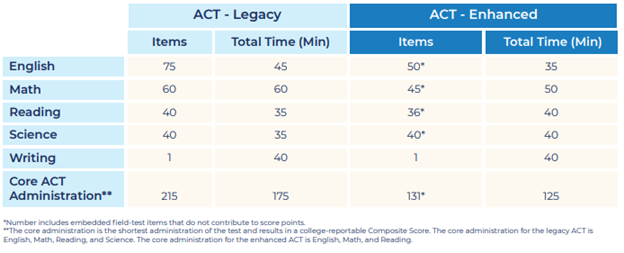
“These changes give all students a fair opportunity to demonstrate what they know in English, math, and reading, and the option to decide whether demonstrating knowledge in science is important to their individual post-high school plans,” said ACT CEO Janet Godwin. “And while the enhanced ACT marks significant changes, the ACT’s predictive validity has not changed.”
Was it a success? The students have spoken:
“I feel like [having more time] significantly helped. When I would do practice tests, I was getting on the edge of the time every single time – this time I had time to review almost every section.”
- Noah Clements, 11th grade, a student from North Caldwell, NJ,
on the shorter time
“I think it’s better [to have a choice] because you might not always need a science-related field. So, if you don’t want to take it, you don’t have to.”
- Abhinav Agnihotri, 10th grade, Coppell, TX,
on choosing to take the science section
“I just kind of wanted to take the science because if I didn’t, it’d be like the same thing as taking the SAT. I want to go into medicine.”
- Addison Barnes, 11th grade, Mansfield, TX,
on choosing to take the science section
“I found it to be challenging, which was good because it’s good to be challenged.”
- Brooklyn Dismuke, 11th grade, Dallas, TX,
on the overall enhanced test
Overall, more than 100,000 students took the ACT on April 5, though only students who
signed up for the online version received the enhanced exam. ACT will continue to roll out the new exam in phases, first in national online testing this spring and summer. Enhanced paper testing will begin during national testing starting in the fall. Students who take the ACT during the school day will experience the enhanced exam in spring 2026.